
Call Us Today
773-839-8800
Strategic Planning’s 4 Elements – Don’t Lose Sight of the Future

Author: Larry Chester, President
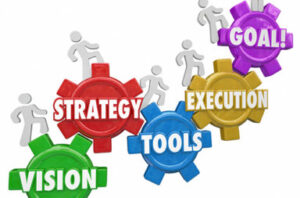 A machine tool distributor had grown his grandfather’s business from $600,000 annually to over $30 million. He had worked hard to achieve great success. Three of his five children were in the business. He wanted to retire soon but had put nothing in place. Who was going to lead the business? How was he going to sell the business to his children without loading them with debt? How was he going to select the child that was best suited to lead the company into the future?
Have you developed your Strategic Plan? Not next year’s budget, but a real plan for where the business is going. Just as a budget defines WHERE you want your business to be at the end of next year, the Strategic Plan defines WHAT you want your business to be in the future. Whether it’s reaching a particular sales level, selling the company, or being able to retire, unless you set a goal, you’re being reactive, not proactive, and your result is at risk.
I recently wrote about turning a strategic plan into a real budget. This is the step before that: building the plan in the first place. It comes down to four elements: Vision, Goals, Tasks, and Timeframe. Each one sounds simple. Each one is also where plans quietly fall apart.
Vision
This is your image of your business. Who do you serve? How do you want to be perceived by your customers and the business community? This is the personality of your business.
But a vision has to start somewhere more personal: what do you, the owner, actually want? Retire in seven years? Sell to a strategic buyer? Hand the business to the next generation? Keep building because you love it? Those are very different businesses, and they need very different plans.
Then comes the part most owners skip. What does the business have to look like financially to support that vision? If you want to sell in five years, a buyer will want consistent profitability, clean and reconciled financials, and a business that doesn’t depend on you. If you want to retire on the company’s income, it has to generate enough cash to pay someone else to run it and still pay you. The vision isn’t complete until you can describe it in numbers.
Once you formulate this Vision, make sure everyone who works for you knows and understands their role in reaching it. If the vision is yours alone, you’ll never achieve it. Here’s a simple test: could your key people describe it in a sentence?
Goals
These specific accomplishments are milestones on the way to your Vision. They’re the points along the way that assure you’re heading in the right direction.
The trouble is that most goals aren’t goals at all. They’re wishes. “Grow the business” is a wish. “Reach $5 million in revenue at a 12% net margin by 2029” is a goal. A real goal has a number and a date, so there’s no argument about whether you hit it.
Goals also have to be realistic, and realistic needs more than just optimism. Can the business actually support it? Growth consumes cash before it produces cash. More sales means more inventory, more receivables, and more people, often before the first new dollar comes in. A goal you can’t fund is a goal you won’t hit.
A small food products company successfully sold their concept to a regional grocer. They got space on the shelf and quickly sold all their inventory. But they lacked enough margin to support a quick resupply to the chain and lost their space on the shelf. They had a successful product and sold their dream customer but couldn’t deliver long term. They had no plan to keep the store stocked and lost their shot at success.
Finally, tie each goal to one or two measures you’ll actually watch. Not a dashboard of twenty numbers, just the few that tell you whether you’re on track.
Tasks
How are you going to accomplish your Goals? Each of those Goals has tasks that must be achieved. No Goal is accomplished overnight. By laying out the tasks to get there, you’ll get to your desired result.
Every task needs two things: an owner and a cost. An owner, because a task that belongs to everyone belongs to no one. A cost, because tasks are where the plan meets the budget. Hiring a salesperson, upgrading software, opening a second location: every one of them has a price tag and a cash requirement.
Some tasks are simply more of what you already do. Others require real change: a new process, a new system, a new role. Those are the ones that get put off, because they’re uncomfortable and the current way still works, more or less. They’re also usually the tasks that matter most. You can’t reach a new level of performance while everything else stays the same.
A distributor of compressed air systems took trade-ins on old systems to pump up sales. It worked, but they were soon stuck with four warehouse bays filled with used, beat-up compressors they didn’t know how to value. We suggested they value the compressors at trade-in cost and use their repair staff and significant parts inventory to refurbish them. Soon their new eBay store sold refurbished equipment that cleared the shelves and brought additional profitability to their bottom line.
Timeframe
When will your Strategic Goals be reached? It’s almost like trying to get to the end of a rainbow. You can see it (you think), and you move toward it. But it keeps moving ahead of you. Your Strategic Plan should be the same way.
A timeframe isn’t just an end date. It’s a rhythm. Every goal needs milestones along the way, and every milestone needs a regular review: monthly for the tasks, quarterly for the goals. Are we where we said we’d be? If not, why not? Is it a timing problem, a resource problem, or was the goal wrong to begin with? A plan that only gets looked at once a year isn’t a plan. It’s a document in a drawer.
Your Strategic Plan can easily be staged, so that there are near-term Strategic Goals and longer-term Strategic Goals. As you make progress on your current plan, revisit the process. Develop a new Plan that takes you to that next level, and then the one beyond that.
The Takeaway
If you don’t have a Strategic Plan, start small. Write down where you want the business to be in five years, and one number that would prove you got there. That’s your first draft. Share it with your key people, break it into goals, assign the tasks, and put the reviews on the calendar.
Keep your plan fresh, keep the goal just out of arm’s reach, and your company will continue to reach forward into the future.
Related Posts
Project Failure – Turn that Frown Upside Down
We’ve all had projects that failed. Hopefully they were small projects, in which case the pain would be small as well. But

Institutional Knowledge: The Asset You Don’t Know You’re Losing
Do Any of These Sound Familiar? A third-generation owner is getting ready to retire. He and his Vice President of

Get Clarity On Your
Company’s Performance
Our people are unique CFOs. They are all operationally
based financial executives.
Contact Us


The information on this website is for informational purposes only; it is deemed accurate but not guaranteed. It does not constitute professional advice. Testimonials are not a guarantee, warranty or prediction of what your experience with us will be. By providing certain contact information herein, you are expressly authorizing the recipient of this message to contact you via the methods of communication provided.
Copyright 2026 All Rights Reserved | Privacy Policy | Accessibility Notice
